
Office Address
308/H-2, Netaji Subhash Place, Pitampura, New Delhi, Delhi, 110034
Phone Number
+91 9650715139
Email Address
hello@shrinext.com
308/H-2, Netaji Subhash Place, Pitampura, New Delhi, Delhi, 110034
+91 9650715139
hello@shrinext.com






Healthcare organizations are rapidly moving toward digital transformation, and Electronic Medical Record (EMR) and Electronic Health Record (EHR) systems have become the foundation of modern healthcare delivery.
At Shrinext HealthTech, we specialize in Custom EMR & EHR Software Development, helping hospitals, clinics, healthcare startups, diagnostic centers, and multi-specialty healthcare networks digitize clinical workflows, improve patient care, and comply with global healthcare regulations.
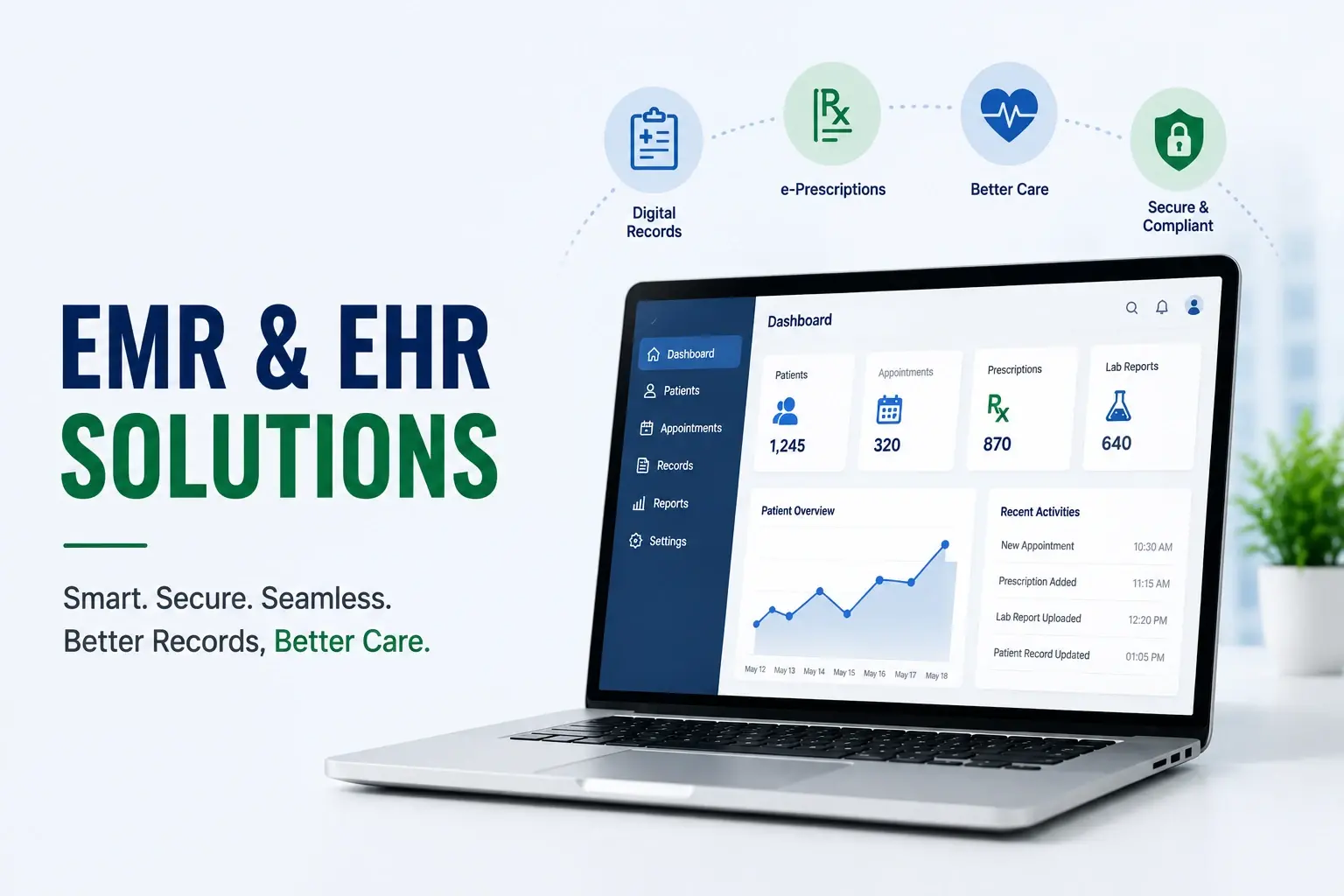
With over 15 years of healthcare software development experience, we build secure, cloud-native, interoperable, and AI-ready EMR/EHR solutions tailored to your organization's unique workflows.
Although the terms are often used interchangeably, they serve different purposes.
An Electronic Medical Record (EMR) is a digital version of a patient's medical chart used within a single healthcare organization. It contains patient demographics, diagnoses, prescriptions, treatment history, clinical notes, and laboratory results.
An Electronic Health Record (EHR) extends beyond a single organization. It securely shares patient information across hospitals, laboratories, pharmacies, specialists, and healthcare providers using interoperability standards such as HL7 and FHIR.
Whether you need an EMR, an enterprise EHR, or a hybrid platform, Shrinext HealthTech can design a solution that meets your clinical and operational requirements.
We develop custom healthcare platforms that simplify patient management while improving clinical efficiency.
Design fully customized Electronic Medical Record and Electronic Health Record systems based on your specialty, workflow, and business requirements.
Manage complete patient information in one secure platform.
Improve operational efficiency with intelligent scheduling.
Digitize medication workflows with secure electronic prescriptions.
Provide healthcare professionals with seamless access to diagnostic information.
Integrate with billing systems to streamline financial operations.
Provide personalized experiences for every user.
Enable secure data exchange between healthcare systems.
Our solutions support:
Access patient records securely from anywhere.
Transform healthcare data into actionable insights.
Generate reports for:
Our EMR & EHR software includes:
Patient data security is at the heart of every solution we build.
Our platforms comply with international healthcare standards including:
Healthcare providers using digital EMR and EHR systems can:
Our healthcare solutions are designed for:
Healthcare software requires deep domain expertise—not just technical skills.
At Shrinext HealthTech, we combine healthcare knowledge with modern software engineering to build secure and scalable digital health platforms.
We follow an agile development approach.
Our EMR & EHR platforms can easily integrate with:
This ensures your healthcare platform is ready for future innovations.
Whether you're building a new Electronic Medical Record platform or modernizing an existing Electronic Health Record system, our experienced healthcare software team can help you create a secure, scalable, and compliant solution.
We build technology that empowers healthcare providers to deliver better care.
Let's build the future of digital healthcare together.
An EMR stores patient records within a single healthcare organization, while an EHR securely shares patient information across multiple healthcare providers using interoperability standards such as HL7 and FHIR.
Yes. We design and develop fully customized EMR and EHR solutions tailored to hospitals, clinics, diagnostic centers, healthcare startups, and NGOs.
Yes. Our healthcare platforms are built with HL7 and FHIR interoperability standards, enabling seamless integration with laboratories, pharmacies, insurance providers, and third-party healthcare systems.
Yes. Security and compliance are built into every solution, including HIPAA, GDPR, role-based access control, encryption, and secure cloud deployment.
Absolutely. We develop cloud-based EMR and EHR systems that integrate with telemedicine platforms, mobile apps, wearable devices, laboratory systems, and patient portals.