Office Address
308/H-2, Netaji Subhash Place, Pitampura, New Delhi, Delhi, 110034
Phone Number
+91 9650715139
Email Address
hello@shrinext.com
308/H-2, Netaji Subhash Place, Pitampura, New Delhi, Delhi, 110034
+91 9650715139
hello@shrinext.com


 by Shrinext HealthTech
Healthcare organizations, NGOs, charitable hospitals, and CSR initiatives are playing an increasingly important role in delivering quality healthcare to underserved communities. However, managing healthcare programs efficiently has become more challenging than ever.
Organizations today must handle patient records, organize medical camps, monitor community health workers, comply with government regulations, and prepare donor reports—all while working with limited budgets and resources.
Unfortunately, many NGOs still depend on paper-based workflows, spreadsheets, or disconnected software systems that slow operations, increase administrative overhead, and make data-driven decision-making difficult.
The good news is that Healthcare SaaS (Software as a Service) is transforming how nonprofit healthcare organizations operate.
Cloud-based healthcare platforms enable NGOs to streamline operations, improve patient care, reduce manual work, and access real-time information from anywhere.
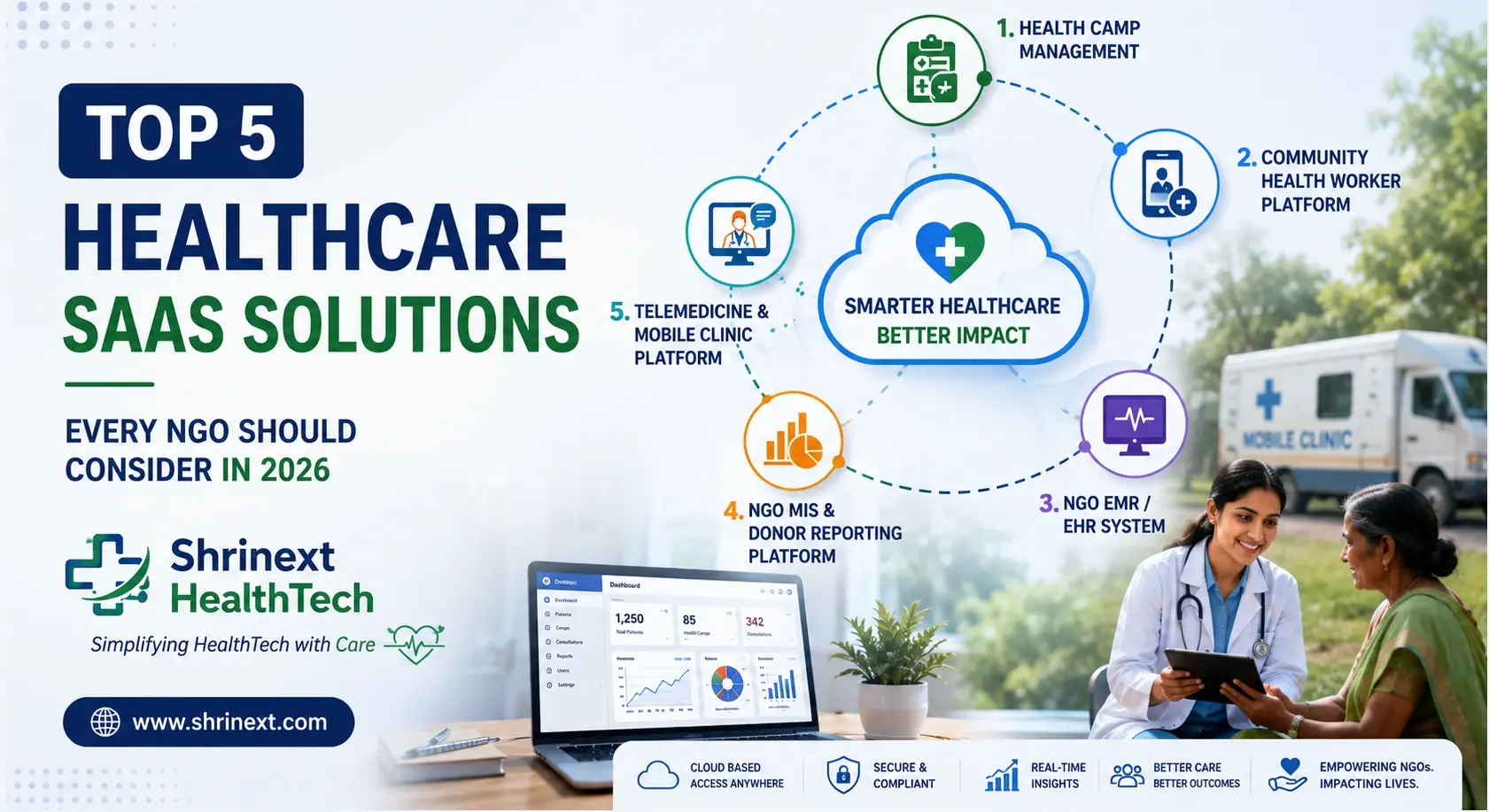
In this article, we'll explore the top five Healthcare SaaS solutions that every NGO should consider in 2026 to improve efficiency, transparency, and healthcare outcomes.
Health camps are one of the most effective ways for NGOs, charitable trusts, and CSR programs to provide preventive healthcare services in rural and underserved communities.
However, managing thousands of patients manually can become overwhelming.
Patient registration, doctor consultations, prescriptions, laboratory reports, pharmacy management, and post-camp reporting often require multiple paper registers and spreadsheets.
A Health Camp Management System digitizes the entire process.
From patient registration to analytics, everything is managed through a centralized cloud platform.
Community Health Workers (CHWs) serve as the bridge between healthcare providers and rural communities.
They conduct household surveys, monitor maternal health, support immunization programs, and follow up with patients.
Many field workers still rely on paper forms that delay reporting and increase the risk of data loss.
A Community Health Worker Platform solves this problem by combining a mobile application with a centralized web dashboard.
Healthcare workers can collect data even without internet connectivity, and the application automatically synchronizes information once connectivity is restored.
This platform helps organizations monitor healthcare activities across multiple villages and districts from a single dashboard.
Electronic Medical Record (EMR) systems available in the market are often designed for large hospitals.
For NGOs and charitable clinics, these systems can be expensive, complicated, and difficult to maintain.
A lightweight NGO EMR/EHR System provides essential clinical functionality without unnecessary complexity.
Healthcare professionals can securely manage patient records while improving the quality and continuity of care.
An NGO EMR system allows healthcare providers to spend more time treating patients and less time managing paperwork.
Healthcare NGOs must do much more than deliver healthcare services.
They must also demonstrate transparency, accountability, and measurable impact to donors, CSR partners, and government agencies.
Preparing these reports manually is often time-consuming and prone to errors.
An NGO MIS (Management Information System) centralizes operational data and automates donor reporting.
Instead of collecting information from multiple spreadsheets, decision-makers can access real-time dashboards and generate reports instantly.
Organizations can focus more on delivering healthcare rather than preparing reports.
Access to healthcare remains a significant challenge in remote and underserved regions.
Telemedicine has emerged as one of the most effective ways to bridge this gap.
Patients can consult qualified doctors remotely without travelling long distances.
When integrated with mobile clinic operations, telemedicine becomes even more powerful.
Healthcare organizations can schedule field visits, maintain electronic patient records, and conduct virtual consultations through a single platform.
Telemedicine allows NGOs to reach thousands of patients while minimizing operational costs.
Healthcare organizations are rapidly moving toward cloud-based software because it offers greater flexibility, lower costs, and improved scalability.
Unlike traditional software, Healthcare SaaS platforms require minimal infrastructure and are accessible from anywhere.
Some of the biggest advantages include:
As NGOs continue expanding healthcare services, cloud-based solutions provide the agility needed to scale operations efficiently.
Healthcare SaaS platforms are becoming even more powerful with Artificial Intelligence.
Modern healthcare applications can now:
AI-powered healthcare platforms help organizations deliver more personalized and efficient care while reducing administrative effort.
At Shrinext HealthTech, we specialize in building secure, scalable, and cloud-native healthcare software for NGOs, hospitals, healthcare startups, public health organizations, and CSR initiatives.
Our solutions are designed to simplify healthcare operations, improve patient outcomes, and accelerate digital transformation.
Every solution is built with scalability, security, compliance, and usability in mind.
The future of healthcare is digital, connected, and data-driven.
Organizations that embrace Healthcare SaaS today will be better equipped to:
Digital transformation is no longer optional—it's becoming essential for every healthcare organization.
Whether you're planning a Health Camp Management System, Community Health Worker Platform, NGO EMR/EHR, Telemedicine Solution, or a complete Healthcare SaaS Platform, our team is ready to help.
We build secure, scalable, and future-ready healthcare applications that empower organizations to deliver better care through technology.
Let's build the future of digital healthcare together.